
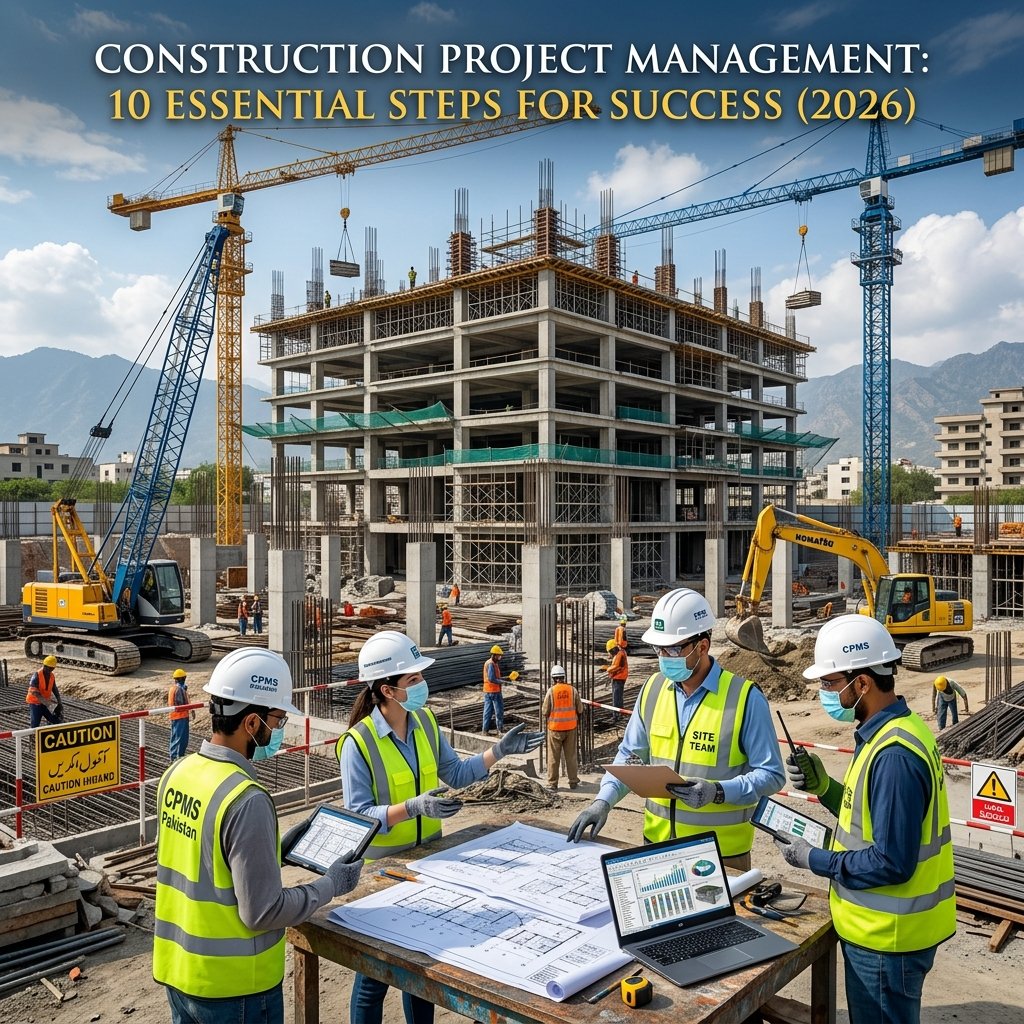
Construction project management is the process of planning, coordinating, and overseeing every phase of a building project—from design and budgeting to site supervision and handover. Effective construction project management reduces cost overruns, prevents delays, ensures quality, and keeps all stakeholders aligned from day one.
Building anything—a home, a commercial plaza, or an industrial facility—is far more complex than it looks from the street. Behind every finished structure is a web of decisions, timelines, budgets, contractors, and materials that must come together in exactly the right sequence. When they don’t, projects stall, costs spiral, and quality suffers.
That’s where construction project management becomes the difference between a smooth build and a costly disaster. For property owners, investors, and developers in Lahore and across Pakistan, understanding how professional construction management works—and why it matters—can save millions of rupees and months of unnecessary stress.
This guide covers everything you need to know: the key phases, the most common mistakes, best practices used by top construction companies, and how Pasban Builders delivers structured, transparent, and results-driven project management on every build.
What Is Construction Project Management?
Construction project management is the discipline of applying specialized knowledge, tools, and techniques to plan, execute, monitor, and close a construction project within defined parameters of scope, time, cost, and quality.
A qualified project manager serves as the central point of coordination—bridging the client, architect, structural engineer, site engineer, contractors, and suppliers into one cohesive operation. Construction management ensures that every decision, from material procurement to labour management, is made strategically rather than reactively.
In Pakistan’s construction industry, where regulatory compliance with bodies like the Pakistan Engineering Council (PEC) and the Lahore Development Authority (LDA) is non-negotiable, structured construction project management also ensures that all building codes and approval requirements are met throughout the project lifecycle.
Why Construction Project Management Is Important
Poor planning is the root cause of most construction failures. According to McKinsey & Company, large construction projects globally run 20% over schedule and up to 80% over budget on average. In Pakistan’s residential and commercial construction sectors, those figures can be even higher when projects lack professional oversight.
Here’s why construction project management is not optional—it’s essential:
- Cost control: A professional project manager prepares detailed BOQs (Bills of Quantities), monitors expenditure in real time, and prevents budget bleed.
- Time management: Structured construction scheduling ensures trades are sequenced correctly and milestones are hit on time.
- Quality assurance: Regular site inspections and quality control protocols ensure materials and workmanship meet agreed standards.
- Risk mitigation: Risk management processes identify potential problems—weather delays, supply chain issues, labour shortages—before they become crises.
- Client communication: Transparent reporting keeps property owners informed and reduces conflict.
Whether you’re building a 5-marla house or a multi-storey commercial plaza, these benefits apply at every scale.
Key Phases of Construction Project Management
Phase 1: Pre-Construction Planning
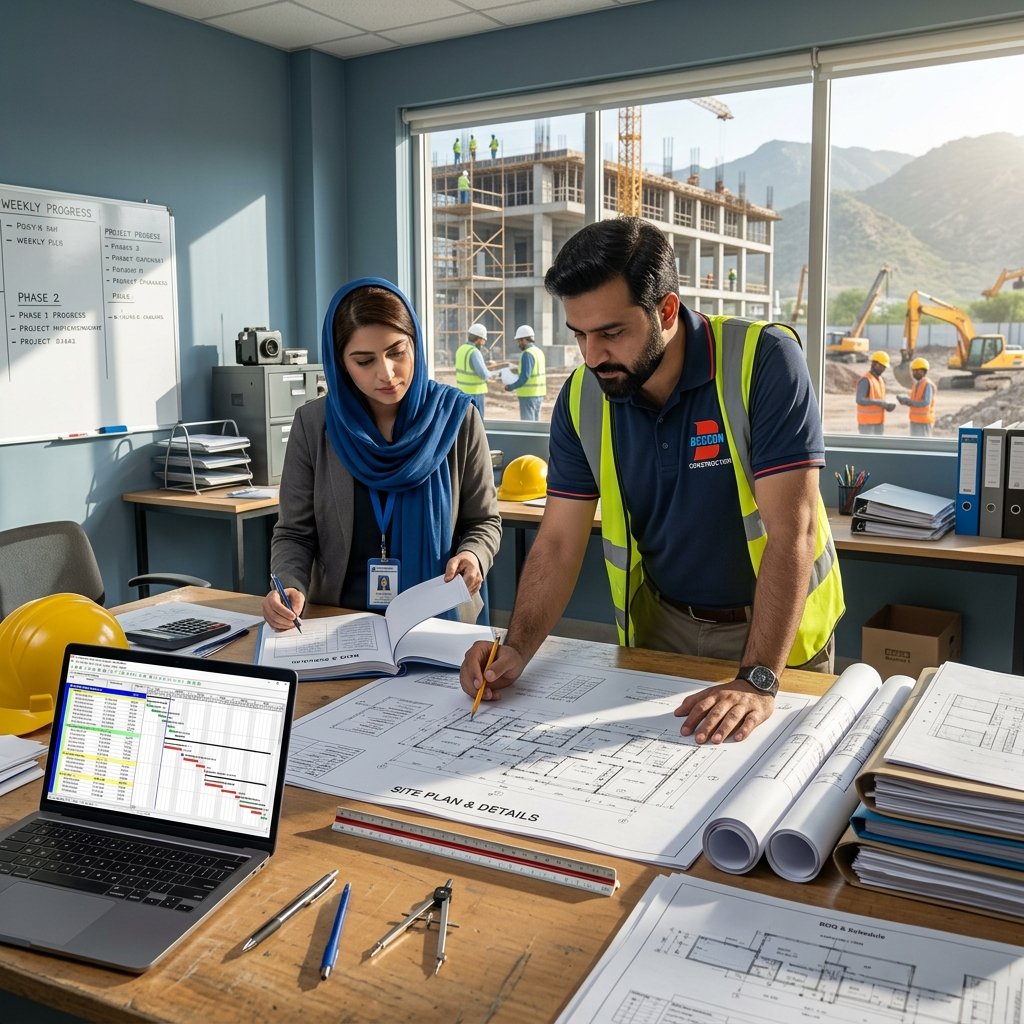
Everything that happens on site is a reflection of what was (or wasn’t) planned beforehand. Pre-construction is the most important phase of construction project management, yet it’s also the most frequently rushed.
During this phase, the project manager works closely with the client, architect, and structural engineer to:
- Define project scope and objectives
- Complete preliminary cost estimation
- Prepare detailed drawings and structural designs
- Obtain necessary permits from LDA and comply with local building codes
- Develop an initial construction schedule with clear milestones
- Finalize the construction budget and BOQ
Skipping or shortcutting pre-construction planning almost always results in costly changes during the build—a phenomenon known as “rework,” which guidelines identify as one of the leading drivers of construction waste in Pakistan.
Phase 2: Design Coordination
Once planning is complete, the architect and structural engineer finalize working drawings. The project manager reviews these for constructability—identifying any design elements that may be difficult to execute, over-budget, or inconsistent with the approved BOQ.
This is also the stage where material specifications are confirmed: grades of cement, steel, and bricks; RCC (Reinforced Cement Concrete) mix designs; foundation type; and grey structure specifications.
Phase 3: Procurement and Resource Planning
Material procurement is both a cost and a timing challenge. Buying too early ties up capital; buying too late stalls construction. A skilled construction project manager plans procurement schedules that align with the build sequence—ensuring cement, steel, bricks, and finishing materials arrive on site exactly when needed.
Resource allocation during this phase also covers labour management: identifying what tradespeople are needed, when, and in what numbers.
Phase 4: Project Execution
This is where ground breaks and the building rises. During project execution, the project manager and site engineer coordinate daily site activities, manage subcontractors and direct labour, track progress against the construction schedule, and enforce quality control standards at every stage—from foundation and grey structure through to finishing.
Phase 5: Monitoring and Control
Construction project management doesn’t stop once work begins. Continuous project monitoring is what separates professional management from reactive supervision.
This includes:
- Weekly site inspections and progress reports
- Budget tracking against actual expenditure
- Schedule variance analysis
- Risk reviews and corrective action
- Client communication updates
Phase 6: Handover and Closeout
The final phase involves completing all snag lists, obtaining occupancy certificates, handing over as-built documentation, and ensuring the client is fully satisfied with the finished building. A structured closeout also includes final account reconciliation and post-construction warranty documentation.
Planning and Scheduling in Construction Management
A construction schedule is more than a list of tasks—it’s the backbone of the entire project. Professional construction scheduling typically uses tools like Gantt charts or Critical Path Method (CPM) analysis to map every activity, its duration, its dependencies, and the resources required.
Key scheduling principles include:
- Float management: Identifying which tasks have flexibility and which are fixed
- Milestone setting: Marking critical checkpoints—foundation complete, grey structure complete, roofing complete—to measure progress
- Look-ahead scheduling: Planning 3–6 weeks ahead to anticipate resource and material needs
- Delay contingency: Building realistic buffers into the project timeline for weather, approval delays, or supply chain disruptions
Budgeting and Cost Control
The construction budget is built from a detailed BOQ that itemizes every material, labour task, and service required for the project. Cost estimation at this level requires deep knowledge of current market rates for materials—cement, steel, bricks, aggregate—as well as labour rates in the local market.
Once the project is underway, cost control involves comparing actual expenditure to the budgeted amounts on a weekly basis. Any variance is flagged immediately, and the project manager works with the client to either adjust scope or identify cost savings elsewhere.
Common budget blowouts in building construction include:
- Unplanned design changes mid-build
- Material price escalations not accounted for in the original estimate
- Delays that extend labour costs
- Poor procurement planning leading to emergency purchasing at premium prices
Risk Management in Construction Projects
Every construction project carries risk. Professional risk management identifies those risks early and puts mitigation strategies in place before they materialize.
A comprehensive risk register for a typical residential or commercial construction project in Lahore might include:
- Design risk: Incomplete or conflicting drawings leading to rework
- Financial risk: Client payment delays or cost overruns
- Supply chain risk: Material shortages or price spikes
- Weather risk: Monsoon season delays to foundation or grey structure work
- Regulatory risk: Approval delays from LDA or other authorities
- Labour risk: Skilled trade shortages or productivity issues
- Safety risk: On-site accidents leading to project stoppages
Each risk is assessed for likelihood and impact, and a response plan is prepared in advance.
Quality Assurance and Quality Control
Quality in construction is not about aesthetics alone—it’s about structural integrity, material compliance, workmanship standards, and long-term durability.
Quality control in construction project management involves:
- Verifying that materials delivered to site match specifications (e.g., correct grade of steel and cement per PSQCA standards)
- Inspecting RCC work before concrete is poured
- Conducting post-pour inspections of foundations, columns, beams, and slabs
- Checking brickwork for plumb, level, and mortar consistency
- Documenting all inspections with photographic records
Quality assurance goes one step further—it’s the system of processes and protocols that prevents quality problems from occurring in the first place.
Site Supervision and Safety Management
Effective construction supervision means having a qualified site engineer present on site daily to oversee operations, resolve problems in real time, and ensure the build proceeds according to drawings and specifications.
Construction safety is equally critical. Pakistan’s construction sector sees a disproportionately high rate of workplace injuries, many of which are preventable with basic safety protocols. A professionally managed site enforces:
- Personal protective equipment (PPE) requirements
- Safe scaffolding and working-at-height procedures
- Proper material storage and handling
- Regular safety briefings for labour
Team Coordination and Client Communication
A construction project involves dozens of parties: the client, architect, structural engineer, project manager, site engineer, main contractor, subcontractors, and material suppliers. Without structured coordination, information gets lost, decisions get delayed, and conflicts arise.
Professional construction project management establishes clear lines of communication, defined roles and responsibilities, and a structured reporting rhythm that keeps every stakeholder informed and aligned.
Comparison: Managed vs. Unmanaged Construction Projects
| Factor | With Professional Construction Management | Without Professional Management |
|---|---|---|
| Budget adherence | High – continuous cost control | Low – frequent overruns |
| Project timeline | On schedule with structured planning | Frequent delays |
| Quality control | Systematic inspections at every phase | Inconsistent and reactive |
| Risk management | Proactive identification and mitigation | Problems addressed after they occur |
| Client communication | Regular structured updates | Ad hoc and informal |
| Regulatory compliance | LDA and PEC compliance built in | High risk of non-compliance |
| Final cost | Typically 10–20% lower overall | Often 20–40% higher due to rework |
Common Construction Project Management Mistakes
Even experienced developers make these errors. Knowing them in advance is half the battle.
1. Starting construction without finalizing drawings
Design changes mid-build are the single biggest driver of cost overruns and delays in residential and commercial construction.
2. Under-estimating the BOQ
Optimistic cost estimation at the outset sets up the project for financial trouble from day one.
3. Skipping site inspections
Without regular, documented site inspections, quality issues compound silently until they become expensive to fix.
4. Poor procurement planning
Ordering materials reactively rather than proactively leads to work stoppages and premium pricing.
5. Inadequate labour management
High turnover and poor supervision of skilled trades erodes quality and schedule simultaneously.
6. No contingency budget
Every construction project should carry a 10–15% contingency reserve. Without it, any unexpected cost becomes a crisis.
Best Practices for Effective Construction Project Management
The most successful construction companies in Pakistan share a common set of operating principles:
- Invest in pre-construction: Every rupee spent in planning saves five to ten in construction.
- Use a detailed BOQ: Never begin procurement or construction without a fully itemized bill of quantities.
- Appoint a dedicated project manager: This person’s sole focus is ensuring your project succeeds.
- Conduct weekly project reviews: Compare actual progress and cost against the plan every week, not every month.
- Document everything: Meeting minutes, inspection records, change orders, and material delivery receipts create accountability and protect all parties.
- Maintain client transparency: Regular reporting builds trust and prevents misunderstandings.
- Engage qualified professionals: Structural engineers, architects, and licensed contractors registered with PEC bring both expertise and accountability.
Why Choose Pasban Builders for Construction Project Management in Lahore?
Pasban Builders is a professional construction company based in Lahore with deep experience across residential construction, commercial construction, and turnkey construction projects. The company applies structured, internationally recognized construction project management principles to every project—regardless of size.
Working with Pasban Builders means:
- Complete project management from design to handover: One point of accountability for the entire project lifecycle
- Transparent BOQ and cost estimation: Clients know exactly what they’re paying for before work begins
- Qualified on-site supervision: Dedicated site engineers ensure quality control and construction safety at every stage
- Strict construction scheduling: Detailed project timelines with regular client updates
- End-to-end material procurement: Strategic sourcing of cement, steel, bricks, and finishing materials at competitive rates
- Full LDA and PEC compliance: All projects are designed and executed in accordance with Lahore’s building codes and regulatory requirements
Whether you’re planning a new home in DHA, a commercial plaza in Gulberg, or a turnkey construction project anywhere in Lahore, Pasban Builders brings the professional construction management expertise to deliver it on time, on budget, and to the highest quality standards.
[Explore Our Services] | [View Our Projects] | [Get a Free Cost Estimate]
Start Your Project with Confidence
Construction project management is not a luxury—it’s the framework that determines whether your building project succeeds or fails. From BOQ preparation and construction scheduling to site inspection and quality control, every element of professional project management exists to protect your investment and deliver the result you envisioned.
If you’re planning a residential or commercial construction project in Lahore, don’t leave its success to chance. Pasban Builders combines technical expertise, transparent processes, and proven project management systems to take your project from concept to completion—without the stress.
Contact Pasban Builders today for a free consultation and cost estimation. Our team of professional project managers, civil engineers, and construction specialists is ready to help you build with confidence.
[Contact Us Now] | [Request a Free BOQ] | [Call Us Today]
Frequently Asked Questions About Construction Project Management
What is construction project management, and why is it important?
Construction project management is the professional discipline of planning, coordinating, and controlling every aspect of a building project—including budgeting, scheduling, quality control, and risk management. Construction project management is important because it reduces cost overruns, prevents delays, ensures quality, and keeps the project compliant with local building codes and regulations.
What are the main phases of construction project management?
The six key phases are: pre-construction planning, design coordination, procurement and resource planning, project execution, monitoring and control, and handover and closeout. Each phase builds on the previous one, and skipping any phase significantly increases project risk.
How does a project manager help control construction costs?
A project manager prepares a detailed BOQ, monitors actual expenditure against the budget weekly, manages procurement strategically to avoid premium buying, and identifies cost-saving opportunities without compromising quality. This systematic approach typically reduces final project costs by 10–20% compared to unmanaged builds.
What is a BOQ in construction, and why is it essential?
A BOQ (Bill of Quantities) is a detailed document listing every material, labour task, and service required for a construction project, along with quantities and costs. It forms the basis of accurate cost estimation, procurement planning, and contractor tendering. Without a BOQ, construction budgets are largely guesswork.
What does grey structure mean in building construction?
Grey structure refers to the completed structural framework of a building—including foundation, RCC columns, beams, slabs, and brickwork—before any finishing, plastering, or internal fitting out begins. Grey structure is one of the most critical stages of building construction, as structural defects at this stage are expensive to correct later.
How long does construction project management typically take for a residential home in Lahore?
The timeline for residential construction in Lahore depends on the size and complexity of the project. A standard 10-marla home typically takes 12–18 months from foundation to handover with professional construction management. Without structured management, the same project can easily run 24–36 months due to delays, rework, and poor scheduling.
What is turnkey construction, and is it the same as construction project management?
Turnkey construction is a delivery model where the contractor manages and completes the entire project—design, procurement, construction, and finishing—and hands over a ready-to-use building to the client. Construction project management is the underlying discipline that makes turnkey construction work. Not all construction project management is turnkey, but all turnkey projects require robust construction project management.
How does construction project management address safety on site?
Professional construction project management includes a dedicated construction safety plan that covers PPE requirements, scaffolding standards, material handling protocols, and regular safety briefings for all workers. Safety is enforced daily by the site engineer and reviewed by the project manager during site inspections.
How do I know if a construction company in Lahore is qualified to manage my project?
Look for companies whose engineers are registered with the Pakistan Engineering Council (PEC), which sets the professional standards for civil engineering practice in Pakistan. Also verify that the company has demonstrated experience in the type of construction you need—residential or commercial—and can provide references, project portfolios, and transparent BOQ documentation.
What is the difference between a project manager and a site engineer in construction?
A project manager oversees the entire construction project at a strategic level—managing budget, schedule, client communication, risk, and overall project delivery. A site engineer is responsible for day-to-day on-site supervision, ensuring work is executed according to drawings, specifications, and quality standards. Both roles are essential for effective construction project management.